Five of Swords Tarot Card Meaning
Five of Swords represents conflict, hollow victory, ego clash. Part of the Minor Arcana's Swords suit, it signals conflict when upright and warns of reconciliation, regret, making amends in reverse. In yes-or-no readings, Five of Swords leans no.
The Five of Swords shows the sharp, messy side of the suit of Swords—where words cut, pride flares, and “winning” can feel strangely empty. As a card of mental energy and communication, it highlights moments when arguments, power plays, or one‑sided victories leave a lingering bad taste.
This card invites you to consider where ego is running the show. Are you fighting to be right instead of to understand? Are you holding onto a grudge, or replaying a conversation long after it ended? The Five of Swords doesn’t shame you for conflict; it simply asks you to notice the cost of your strategies, and whether keeping score is actually giving you the life and relationships you want.
Key Themes
Upright
Reversed
Artwork & Symbolism
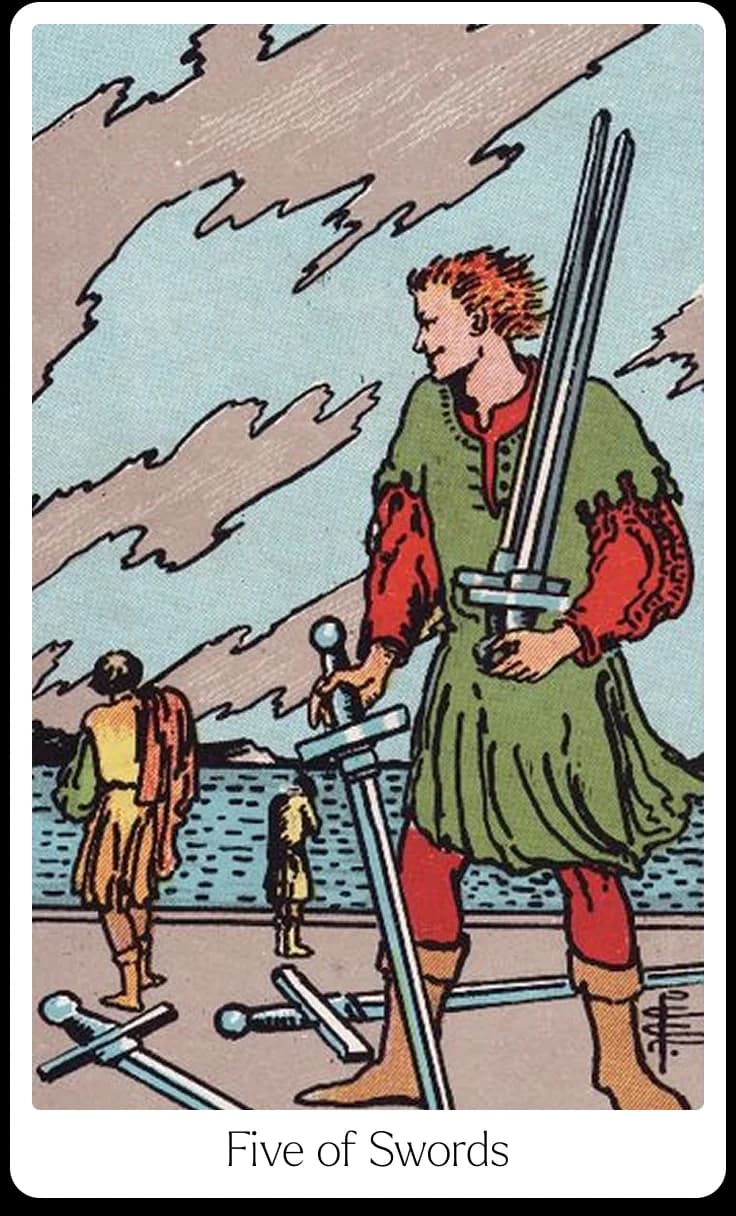
Your eye goes straight to the young man in the right foreground, smirking as he grips two swords—one planted down into the hard ground, one hoisted over his shoulder like a trophy. That posture screams control and ego: you can “win” by force of words, but it lands heavy, not clean. The other three swords lie scattered at his feet, turned into leftovers of the fight—proof of conflict that keeps cutting even after it’s over.
Look left and you see the cost: one figure walks away, glancing back, while another hunches by the water with his head bowed, worn down by what was said. The barren earth underlines the emptiness of a hollow victory, and the choppy water and streaked, windy sky keep the air charged—resentment still rippling long after the argument ends.
Five of Swords Upright
Upright, the Five of Swords points to conflict that has gotten sharp or lopsided. Someone may be “winning” an argument, getting the last word, or grabbing the upper hand—but the atmosphere is tense, and connection is frayed. This can look like subtle manipulation, icy silence, or straight‑up verbal battles.
The card invites you to pause and examine your motives. Are you defending a real need or just your pride? Is this a boundary, or is it a power move? Upright, the Five of Swords suggests it might be time to step back, cool off, and decide what matters more: being right, or being in integrity with yourself and others.
Five of Swords Reversed
Reversed, the Five of Swords often signals a turning point after tension—either a chance to make peace, or a decision to stop engaging in the same draining fights. The word “reversed” here leans toward repair: apologies, honest talks, or quietly choosing to lay down your sword and walk away.
It can also show regret over harsh words or past conflicts, and the emotional hangover that follows. Instead of spiraling into shame, this card asks: What can you learn from how you handled this? How can you show up differently next time—clear, firm, but not destructive?
Five of Swords in Love
In love and relationships, the Five of Swords can feel like that argument where nobody really listens, everyone talks over each other, and afterward the room is thick with resentment. It points to score‑keeping, sarcasm, or using sensitive information as ammunition instead of protection.
This card invites you to notice how you fight. Are you trying to understand your partner, or to win? Are old hurts being weaponized instead of healed? The Five of Swords suggests it may be time to call a truce, own your part, and rebuild trust—or, if the dynamic is chronically cruel or manipulative, to consider whether staying in this battle is actually loving to yourself.
Five of Swords in Career
In career and work, the Five of Swords highlights office politics, underhanded competition, or a win‑at‑all‑costs culture. You might be dealing with colleagues who take credit, twist narratives, or push their agenda with little regard for the team. You could also be tempted to cut corners or play the same game just to keep up.
This card asks where your professional integrity lines are. What are you not willing to do for a promotion, a contract, or approval? Instead of getting sucked into drama, the Five of Swords encourages clear boundaries, documented communication, and, when possible, stepping out of no‑win power struggles to focus on work you can stand behind.
Five of Swords in Personal Growth
For personal growth, the Five of Swords is an invitation to examine your relationship with conflict itself. Do you avoid it until you explode? Do you bulldoze others so you don’t have to feel vulnerable? Do you replay arguments in your head, crafting the perfect comeback long after it’s over?
This card nudges you toward more conscious conflict: naming your needs without attacking, listening even when you’re defensive, and recognizing when your inner critic is turning everything into a battle. Growth here looks like learning to put down the sword—not because you’re weak, but because you’re strong enough to choose peace over ego.
Five of Swords as Daily Guidance
As a daily card, the Five of Swords suggests watching your words and your reactions. Today, it may be wiser to step away from an argument, soften your tone, or let a minor slight pass instead of escalating it into a full‑blown fight. Protect your energy by choosing which battles are truly worth engaging in.
Five of Swords — Yes or No?
Is Five of Swords a yes or no card? Five of Swords is generally a no card. The Five of Swords leans toward conflict, hollow wins, and strained outcomes, so it’s not supportive of a straightforward yes. If you proceed, expect friction and ask whether the cost is worth it.
Five of Swords as Feelings
As feelings, the Five of Swords can be a mix of defensiveness, irritation, and emotional distance. Someone may feel on guard around you, like they need to protect themselves or stay one step ahead. There can be a sense of “I can’t let them see me lose” or “I’d rather pull back than admit I’m hurt.” Underneath the sharp edges is often disappointment or shame—wanting connection, but feeling too bruised or proud to reach out first.
Five of Swords as a Person
As a person, the Five of Swords can describe someone sharp‑minded, quick with comebacks, and highly competitive, who struggles to soften or admit vulnerability. They might be good in a debate but not great at apologies, prone to holding grudges or keeping mental score. At their best, they’re strategic and unafraid of tough conversations; at their worst, they can be cutting, manipulative, or more invested in winning than in being fair or kind.
How Different Decks Interpret Five of Swords
Each tarot deck brings its own artistic voice and interpretive lens. Here's how 3 artists from Flickerdeck approach this card.

City Goddess Deck
by Written By: Meiko J. Harris Illustrated By: Jelly Collazo
Rather than treating the Five of Swords as merely an ego-driven empty win, this deck reads it as ancestral boundary enforcement — a one-time mercy from spirit that calls for integrity over pride or face another, merciless reckoning.
Neon Tarot
by Art: Katya Kirtoka Curator: Iurii Nazarenco
This deck treats the Five of Swords as a consciousness-choice issue: it focuses less on who’s offended and more on which parts of your awareness you’re protecting by keeping score.

Solar Logos tarot
by Keri Bevan
Rather than focusing only on the clash or who 'won,' Solar Logos centers the inner moral and relational cost, urging accountability and realignment with your authentic self.
Five of Swords in a Reading
In a reading, the Five of Swords often flags a situation where communication has turned into combat and someone is likely to walk away feeling bruised. In challenge or “obstacle” positions, it can point to sabotage—whether from others or from your own defensiveness and harsh self‑talk.
In advice or “action” positions, this card asks you to choose your strategy consciously: de‑escalate, clarify your boundaries, or, if necessary, disengage from toxic power struggles. Paired with gentler cards, it can mark a tough but honest conversation that clears the air; with other intense cards, it can spotlight conflicts that genuinely require distance or a firm line in the sand.
Frequently Asked Questions
Is Five of Swords a yes or no card?
What does Five of Swords mean in love?
What does Five of Swords mean for career?
What does Five of Swords represent as feelings?
What does Five of Swords reversed mean?
Experience Five of Swords through City Goddess Deck's unique voice in Flickerdeck
Discover tarot through dozens of artistic lenses — do readings, explore decks, and find the interpretation that resonates with you.
Get Flickerdeck